HAL LEONARD
See Amid the Winter's Snow New

Model: 48025756

The lovely words, which the Todd adapted slightly from the 19th-century carol by Edward Caswall, has been a part of his Christmas celebrations for as long as he can remember, and there are several wonderful tunes associated with the text. In writing this new melody, Todd wanted to explore again the timeless nature of the poetry.
MORE»

List: 2.65

See all new items from HAL LEONARD»

HAL LEONARD
Preludes for Piano New

Model: 50607749

In 1929, Olivier Messiaen finished composing his Préludes. The first original work for piano of a twenty-one-year-old composer, it would be the first to be included in his official catalogue. This collection of Messiaens, an early work, written as a tribute to his mother, who died prematurely in 1927, offers a unique insight into his writing: a poetic universe coloured by a spatial concept of sound, a refined and sensual sense of legato, and a subtle, understated way with rhythm: these are the many beacons that will guide us in our approach. Messiaen, a true synesthete, associates different colours to each of his preludes. Introduction and notes on interpretation in French and English by Edmond Lemaître.- New engraving.
MORE»

List: 28.99

See all new items from HAL LEONARD»

HAL LEONARD
LCME Piano Handbook 2026: Grade 8 (Exam Material) New

Model: 02165648

The essential Grade 8 piano repertoire book, with twelve pieces and two studies carefully selected and edited by top UK piano educators, complete with handy practice tips. Free technical work, sight-reading, and aural materials are available from the LCME website.
MORE»

List: 22.99

See all new items from HAL LEONARD»

HAL LEONARD
Hungarian Rhapsody No. 11 (Piano Solo) New

Model: 51481714

The eleventh Hungarian Rhapsody, published in 1853, is based on four themes of Hungarian character whose origins have not yet been determined: Liszt may have noted them down by ear during his trip to Hungary in 1846. Introduced by a soft tremolo quasi cimbalo, a folk-like song, a dance and two csárdás compositions are heard one after the other, whereby echoes of the then popular so-called “gypsy bands” are unmistakable. In a manner unique even within the cosmos of the “Rhapsody” series, the tempo is increased in each new section and the piano texture becomes denser. Parallel to this, the harmonic scope widens, whereby the journey leads from A minor through A major to the brilliant stretta in F-sharp major. For the Urtext edition, which for the first time also takes into account the preserved autograph, two renowned Liszt specialists could once again be engaged: Mária Eckhardt for the preface and Vincenzo Maltempo for the fingerings.
MORE»

List: 15.95

See all new items from HAL LEONARD»

HAL LEONARD
Spark! New

Model: 04009858

The title says it all. This work for more advanced concert bands is nothing but electricity. Sweeping woodwing lines, firey brass, driving percussion and biting rhythmical intensity!
MORE»

List: 85.00

See all new items from HAL LEONARD»

HAL LEONARD
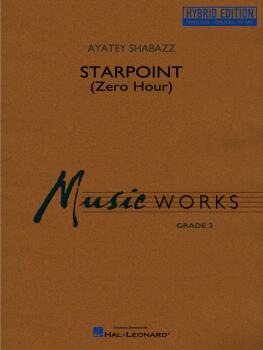
Starpoint (Zero Hour) Hybrid Edition New

Model: 04010060

An adventurous and exciting work with a unique, futuristic, and cinematic sound. Fresh harmonies and colorful orchestrations will make your band sound like they are on a Hollywood soundstage, and the solid scoring, along with comfortable ranges and rhythms, make it highly accessible.

This hybrid edition contains a printed score and access to digital parts.
MORE»

List: 75.00

See all new items from HAL LEONARD»

HAL LEONARD
The Christmas Song (Chestnuts Roasting On An Open Fire) Full Score New

Model: 07014562

This Cuban son mantuno setting of the beloved Christmas hit fits like a glove, and the flute adds the perfect palette of color. Lead trumpet plays A and lead Trombone plays F. Highly accessible and lots of fun!
MORE»

List: 7.50

See all new items from HAL LEONARD»

HAL LEONARD
Arietta (From Three Short Pieces for Organ, No. 3): String Orchestra F New

Model: 02119558

Arietta dates from 1898, the same year as Coleridge-Taylor's Opus 33 Ballade for Orchestra and his Opus 30 cantata Song of Hiawatha, which is based on American Henry Wadsworth Longfellow's epic poem and remains his most-performed work. While certainly typical of the late 19th Century, many of his creations display inspiration by African musical elements much like dances from Hungary had inspired Brahms and Native American melodies and Negro Spirituals inspired Dvorák's New World Symphony.
MORE»

List: 7.00

See all new items from HAL LEONARD»

HAL LEONARD
Very Easy Melodious Exercisesin the First Position Op. 22: Violin and New

Model: 51481724

After Elgar achieved huge success with the publication of Salut damour, in 1889 he attempted to establish himself in London and to live as a freelance artist. However, he was not able to gain a proper foothold, which is why the Elgars moved back to the countryside in Malvern in 1891. There, the composer had a steady flow of students and was able to make a good living as a violin teacher. The Very Easy Melodious Exercises for violin and piano date from this time. Originally composed for his niece, May Grafton, they reflect Elgars renewed interest in teaching. Traces of this activity are displayed in the autograph, which was apparently used in violin lessons and contains numerous fingerings that are missing from the edition published in 1892. In his Urtext edition, British Elgar expert and violinist Rupert Marshall-Luck documents these details in his usual meticulous manner, and in this way creates a newly verified musical text of this classic for violin teaching.
MORE»

List: 19.95

See all new items from HAL LEONARD»

HAL LEONARD
The Fate Of Ophelia New

Model: 04009899

Another smash hit from Taylor Swift means instant buy-in from the students and a concert favorite. This highy accessible arrangement can be put together on little rehearsal time and makes for the perfect last-minute addition.
MORE»

List: 65.00

See all new items from HAL LEONARD»

HAL LEONARD
String Quartet No. 4 (Study Score) New

Model: 51487424

Even before his String Quartet no. 3 appeared in print in 1929, Bartók was already working on a fourth in the summer of 1928. This five-movement work is arranged symmetrically around a highly expressive middle movement dominated by the cello, and calls for various playing techniques such as pizzicato glissandi and the famous “Bartók pizzicato” in which the string is snapped audibly against the fingerboard. Premiered to great success in London in February 1929, it was published in late 1929/early 1930 - however with so many errors that a revised edition of the score was issued already in 1932. In their edition, László Somfai and Zsombor Németh have also consulted Bartók's letters for interesting details about performing the work. These are given as footnotes in this Urtext edition. In addition, the “Notes on performance practice,” which are already obligatory in Henle's Bartók editions, provide information on performing the Bartók pizzicato and on many other issues.
MORE»

List: 19.95

See all new items from HAL LEONARD»