

HPS 764
MORE»
| List | $27.99 |
| Price | $25.19 (Save: $2.80) |

| List | $60.00 |
| Price | $54.00 (Save: $6.00) |

The autograph score of the Quartets op. 17 was in the possession of the imperial police chief Johann Nepomuk Neuwirth, whose widow gave it to the Wiener Gesellschaft der Musikfreunde in 1875. It is said that Haydn “used to play the viola in quartet rehearsals” at the Neuwirth's house. Whether the Quartets op. 17 were composed for these gatherings can no longer be ascertained. However, even today they still have a fixed place amongst the music of all chamber music friends – and in particular nos. 4, 5 and 6, which are very different to the divertimento style of the early quartets, are played again and again.
MORE»
| List | $72.95 |
| Price | $65.66 (Save: $7.29) |
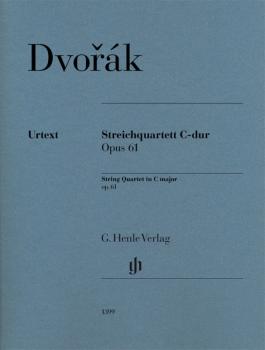
Composed in autumn of 1881, Opus 61 is the last of Dvorak's “middle” quartets by chronology for which Beethoven and Schubert served as the most significant models. Beethoven's influence, from thematic development to motivic treatment, is particularly noticeable in this work in C major. It is only in the finale that the typical Slavic tonal quality usually found in Dvorak's music surfaces somewhat more prominently. Due to a lack of time, the composer - contrary to his usual practice - turned to older, either discarded or hitherto unpublished themes from other works for three of the four movements. This reliable Urtext edition continues the comprehensive Henle series of significant works of chamber music by Dvorak.
MORE»
| List | $27.95 |
| Price | $25.16 (Save: $2.79) |
Clothbound
Contents:
String Quartets
String Quartet no. 1 op. 7 (BB 52)
String Quartet no. 2 op. 17 (BB 75)
String Quartet no. 3 (BB 93)
String Quartet no. 4 (BB 95)
String Quartet no. 5 (BB 110)
String Quartet no. 6 (BB 119)
Appendix
Bartók's analysis of String Quartets nos. 4 and 5
MORE»
| List | $489.00 |
| Price | $440.10 (Save: $48.90) |
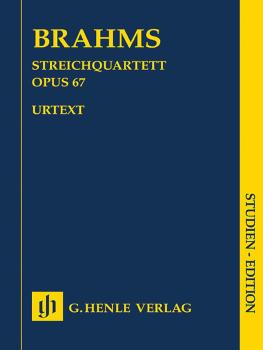
Brahms had already composed over 20 string quartets (he confessed to a friend that he had burnt all of that “stuff”) before he finally presented his Opus 51 to the public. In the end only three surviving works managed to withstand his high self-criticism; numerous layers of corrections bear witness to his struggle with each detail. We are now publishing the two passionate dark Quartets op. 51 separately from the rather more lively Opus 67. The basis for this edition is the volume in the New Complete Edition of Brahms' works, published in 2004 by Henle, for which previously missing sources in a Swiss bequest were consulted for the first time.
MORE»
| List | $14.95 |
| Price | $13.46 (Save: $1.49) |
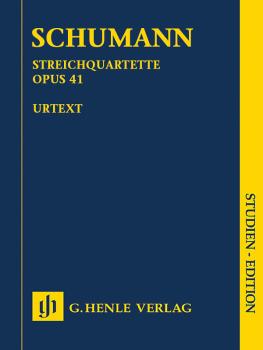
Although Schumann's first attempts at composing for this supreme form of chamber music in 1838-1839 were only fragments, the three String Quartets Op. 41 in A minor, F Major and A Major were written in one go in June/July 1842. At the first private performances the audience was enthusiastic and it was Mendelssohn's praise in particular that occasioned Schumann to dedicate the new works to him. The composer wrote to his publisher in an appropriately confident manner: “Be assured, I have spared no pains in creating something very decent, indeed I sometimes think it is my best”. As is generally known, today Schumann's Opus 41 forms part of the core repertoire for quartet players.
MORE»
| List | $36.95 |
| Price | $33.26 (Save: $3.69) |
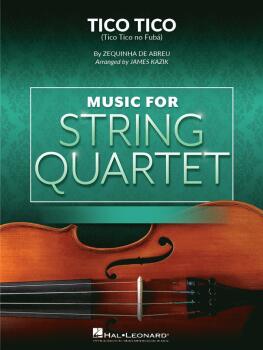
The Brazilian classic was popular in the United States during the 1940s with artists such as Ethel Smith, the Andrews Sisters, and Carmen Miranda. More recently, it was performed at the closing ceremonies of the 2016 Olympics in Brazil. James Kazik's masterful arrangement for string quartet captures all the fun and energy of the original in a format that will be easily performable by your students and the audience dancing in the aisles!
MORE»
| List | $14.99 |
| Price | $13.49 (Save: $1.50) |

Another Shostakovich masterwork string quartet, in an authentic Russian edition.
MORE»
| List | $26.00 |
| Price | $23.40 (Save: $2.60) |
| List | $73.00 |
| Price | $65.70 (Save: $7.30) |

| List | $21.99 |
| Price | $19.79 (Save: $2.20) |
Study Score available: 48001986.
MORE»
| List | $35.00 |
| Price | $31.50 (Save: $3.50) |

| List | $60.00 |
| Price | $54.00 (Save: $6.00) |
Inspired by J. Edgar Hoover, who directed the F.B.I. from 1924 until his death in 1972. Hoover's grim, threatening, yet darkly comic personality is ever-present in this work. Incorporates pre-recorded sound samples of Hoover's voice, an interesting twist on the director's wiretapping.
MORE»
| List | $17.99 |
| Price | $16.19 (Save: $1.80) |
1936 was Hans Winterberg's most fruitful creative year before the catastrophe that befell Czechoslovakia with the annexation of the Sudeten territories in 1938 and the “rest of Czechoslovakia” in 1939 by Nazi Germany. Winterberg lived as a freelance composer in Prague, had found his own style after studying with Alexander von Zemlinsky, among others, and ventured into the great forms of the tradition for the first time: piano sonata, symphony and string quartet. Winterberg's First String Quartet, whose manuscript survived the turmoil of the war and was not premiered until 2024, “a masterpiece not only of Czech music but of the entire string quartet repertoire of the 20th century” (Michael Haas), is perhaps his most complex, most demanding work from the pre-war period. In terms of the interpretational challenges and the peculiarities of its stylistic approach, it lies at the interface between the quartets of Janácek and his pupil Pavel Haas and the quartet compositions of the protagonists of the Second Viennese School.
MORE»
| List | $25.99 |
| Price | $23.39 (Save: $2.60) |
Each of the four string quartets by the Bohemian composer Hans Winterberg (1901-1991) has its own unusual history. The first, composed in happy times in Prague in 1936, had to wait until 2024 for its premiere. The second was composed under dramatic circumstances in the war year 1942, when Winterberg, by a twist of fate, was not deported to the Theresienstadt concentration camp like his colleagues Viktor Ullmann, Pavel Haas, Hans Krása and Gideon Klein, thus surviving the Shoah. The third, like all his other works not published during his lifetime, was composed in 1957, at another existentially difficult time after his great success as a composer in Munich in the early 1950s, where he had fled shortly before the Communists seized power in Czechoslovakia in 1947. Due to its enormous interpretative challenges, it was not until 1970 that Winterberg found an ensemble in the legendary Sonnleitner Quartet - members of the Munich Philharmonic - that could do justice to the technical and emotional demands of the work.
This first edition of the second string quartet documents both versions of the quartet: the original from 1957 and the second with the retouching that the composer made after the failure of the first performance in 1969 by the concertmaster quartet of the Bavarian Radio Symphony Orchestra.
MORE»
| List | $45.00 |
| Price | $40.50 (Save: $4.50) |
Hans Winterberg's four string quartets were composed over a period of four decades between 1936 and 1961 and reflect the four stages of his eventful biography. He composed the first in what were probably the happiest moments of his life in his native city of Prague, the second under great hardship in the terrible war year of 1942, the third in 1957 during a phase of great compositional success in his adopted home of Munich, and the fourth in another dramatic phase of his life. It came at a moment of renewed doubt and uncertainty, when a young generation of composers in Europe was vehemently asserting itself, breaking with all traditions because it considered them obsolete and corrupted by fascism. Winterberg, a survivor of the Shoah, did not break with the past, but rather tried to continue the Czech-German-Jewish cultural symbiosis in his compositions after the war. The fourth quartet marks the beginning of a new creative phase in which he succeeded in combining the very different influences that shaped him - the Bohemian-Moravian, folk-inspired tradition as a successor of Janácek and the achievements of the Second Viennese School, imparted byhis teacher Alexander Zemlinsky - into a homogeneous, rhythmically pointed and expressive style.
MORE»
| List | $25.99 |
| Price | $23.39 (Save: $2.60) |

Kurt Weill (1900-1950) wrote few chamber works, and all of it early in his composing career. This three-movement string quartet represented an important period of progress for the young composer.
MORE»
| List | $39.95 |
| Price | $35.96 (Save: $3.99) |

Includes extracts from The Four Seasons, as well as other less well-known instrumental and vocal music.
MORE»
| List | $24.99 |
| Price | $22.49 (Save: $2.50) |